Novo blog - New Blog

Para outros livros sobre matemática e ensino da matemática procure em: http://livros-matema.blogspot.com/

---------------------------------------------------------------

For other books about mathematics and mathematics education try: http://livros-matema.blogspot.com/.

sábado, 22 de março de 2014

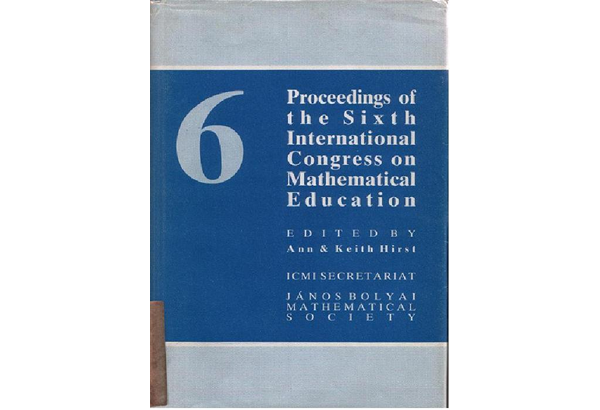
Proceedings of the Sixth International Congress on Mathematical Education


ICME-6    1988      Budapest (Hungary) 

Ann & Keith Hirst

Janos Bolyai Mathematical Society | 398 páginas 

pdf (no OCR) | 38 Mb
online: mathematik.uni-bielefeld.de

djvu (OCR)| 21,6 Mb
online: mathematik.uni-bielefeld.de

The contributions to the Fifth Day Special were published in C. Keitel, A. Bishop, P. Damerow & P. Gerdes (Eds.) Mathematics, Education, and Society. Paris, UNESCO, Science and Technology Education, Document Series, 1989. 

Para outros livros relacionados procure em: link

Contents
Foreword (p. 5) 
Plenary Presentations B. Nebres: School Mathematics in the 1990's: the Challenge of Change especially for Developing Countries (p. 11) G. Vergnaud: Theoretical Frameworks and Empirical Facts in the Psychology of Mathematics Educationn (p. 29) A. Ershov: Computerization of Schools and Mathematical Education (p. 49) L. Lovász: Algorithmic Mathematics: An Old Aspect with a New Emphasis (p. 67) J. - P. Kahane: La Grande Figure de Georges Polya (p. 79) 
Action Groups A1. L. P. Steffe: Early Childhood Years (Ages 4 - 8) (p. 101) A2. A. C. J. Colomb: Elementary School (Ages 7-12) (p. 117) A3. I. Hirabayashi: Junior Secondary School (Ages 11-16) (p. 133) A4. J. Da Lange: Senior Secondary School (Ages 15-19) (p. 143) A5. J. Mack: Tertiary (Post-Secondary) academic institutions (ages 18+) (p. 159) A6. W. Dörfler: Pre-Service Teacher Education (p. 177) A7. R. Strässer: Adult, Technical and Vocational Education (p. 191) 
Theme Groups T1. P. A. House: The Profession of Teaching (p. 205) T2. R. Fraser: Computers and the Teaching of Mathematics (p. 215) T3. M. Niss: Problem Solving, Modelling and Applications (p. 237) T4. D. F. Robitaille: Evaluation and Assessment (p. 253) T5. N. Balacheff: The Practice of Teaching and Research in Didactics (p. 263) T6. W. Blum: Mathematics and Other Subjects (p. 277) T7. H. Burkhardt, J. A. Malone: Curriculum Towards the Year 2000 (p. 293) 
Fifth Day Special: MES A. Bishop, P. Damerow, P. Gerdes, Ch. Keitel: Mathematics, Education, Society (p. 311) 


Topic Areas and International Study Groups 
To1. M. Emmer: Video, Film (p. 329) 
To2. I. Lénárt: Visualization (p. 332) 
To3. G. Berzsenyi: Competitions (p. 334) 
To4. E. Csocsán: Problems of Handicapped Students (p. 339) 
To5. D. A. Quadling: Comparative Education (p. 342) 
To6. K. J. Travers: Probability Theory and Statistics (p. 346) 
To7. D. Pimm: Proofs, Justification and Conviction (p. 350) 
To8. C. Laborde: Language and Mathematics (p. 354) 
To9. [NOT LISTED] 
To10. P. S. Kenderov: Students of High Ability (p. 358) 
To11. D. Singmaster: Mathematical Games and Recreation (p. 361) 
To12. [NOT LISTED] 
To13. L. Burton: Women and Mathematics (p. 365) 
To14. [NOT LISTED] 
To15. H.-G. Steiner: Theory of Mathematics Education (p. 371) 
To16. W. R. Bloom: Spaces and Geometry (p. 375) 
To17. G. König: Information and Documentation (p. 379) 
To18. B. Christiansen, P. F. L. Verstappen: Systematic Cooperation between Theory and Practice in Mathematics Education (p. 382) 
HPM. U. D'Ambrosio: History and Pedagogy of Mathematics (p. 389) 
Projects (p. 393) 
ICMI 
A. G. Howson: The International Commission on Mathematical Instruction (p. 395) 
Projects (p. 393) 
ICMI 
A. G. Howson: The International Commission on Mathematical Instruction (p. 395) 
terça-feira, 18 de março de 2014

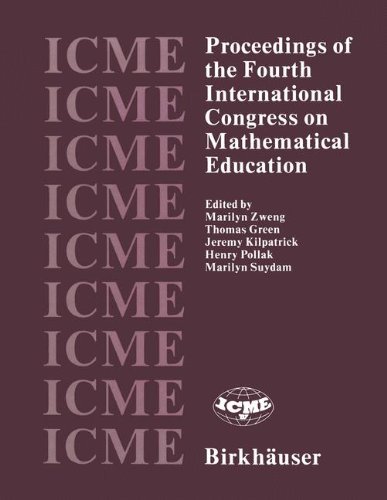
Proceedings of the Fourth International Congress on Mathematical Education


Marilyn Zweng, Thomas Green, Jeremy Kilpatrick, Henry Pollak, Marilyn Suydam


ICME-4    1980      Berkeley (USA)

Birkhäuser Boston | 1983 | 739 páginas | pdf 

124 Mb | online (no OCR): mathematik.uni-bielefeld.de

djvu (OCR) - 64,9 Mb
online: mathematik.uni-bielefeld.de

Para outros livros relacionados procure em: link

TABLE OF CONTENTS
CHAPTER I - Plenary Session Addresses
1.1 Mathematics Improves the Mind
George Polya
1.2 Major Problems of Mathematics Education
Hans Freudenthal
1.3 Young Children's Acquisition of Language and Understanding of Mathematics
Hermina Sinclair
1.4 Reactions to Hermina Sinclair's Plenary Lecture 13
Bill Higginson
Some Experiences in Popularizing Mathematical Methods
Hua Loo-keng
Reactions to Hua Loo-keng's Plenary Lecture 23
Dorothy Bernstein, J.S. Gyakye Jackson
CHAPTER 2 - Universal Basic Education 27
2.1 Mathematics in General Primary Education
Romanus O. Ohuche
2.2 Back-to-Basics: Past, Present, Future
Max Sobel
2.3 Suggested Mathematics Curricula for Students Who Leave School at Early Ages
Shirley Frye, Alonso B. Viteri Garrido
CHAPTER 3 - Elementary Education  36
3.1 Roots of Failure in Primary School Arithmetic
Frederique Papy
3.2 Do We Still Need Fractions in the ELementary Curriculum?
Peter Hilton, Mary Laycock
CHAPTER 4 - Post-Secondary Education 44
4.1 Decline in Post-Secondary Students Continuing the Study of Mathematics
James T. Fey, R.R. McLone, Bienvenide F. Nebres
4.2 Is Calculus Essential? 50
Margaret E. Rayner, Fred Roberts
4.3 Mathematics and the Physical Science and Engineering
Gerhard Becker, Daniela Gori-Giorgi, Jean-Pierre Provost
4.4 Why We Must and How We Can Improve the Teaching of Post-Secondary Mathematics
Henry L. Alder, Detlef Laugwitz
4.5 Alternate Approaches to Beginning'the Teaching of Calculus and the Effectiveness of These Methods
George Papy, Daniel Reisz
4.6 In What Ways Have the Mathematical Preparation of Students for Post-Secondary Mathematics Courses Changed? 70
Kathleen Cross, S.M. Sharfuddin
4.7 Curriculum for A Mathematical Sciences Major
Alan Tucker
4.8 University Programs with an Industrial Problem Focus
Jerome Spanier, Germund Dahlquist, A.Clayton Aucoin, Willian E. Boyce, J.L. Agnew
CHAPTER 5 - The Profession of Teoching 89
5.1 Current Status and Trends in Teacher Education
David Alexander, Jeffrey Baxter, Sr. lluminada C. Coronel, f.m.m., Hilary Shuard
5.2 Integration of Content and Pedagogy in Pre-Service Teacher Education
Zbigniew Semadeni, Julian Weissglass
5.3 Preparation in Mathematics of a Prospective Elementary Teacher Today, in View of the Current Trends in Mathematics, in Schools, and in Society 100
James E. Schultz
5.4 Evaluation of Teachers and Their Teaching 102
Thomas J. Cooney, Edward C. Jacobsen
5.5 Hand-held Calculators and Teacher Education 107
Willy Vanhamme
5.6 Computers in Mathematics Teacher Education 109
Rosemary Fraser
5.7 The Mathematicol Preparation of Secondary Teachers - Content and Method
Trevor Fletcher
5.8 Special Assistance for the Beginning Teacher
Edith Biggs, Mervyn DlKlkley
5.9 The Making of a Professional Mathematics Teacher
Gerald Rising, Geoffry Howson
5.10 The Dilemma of Teachers Between Teaching What They Like and Teaching What the Pupils Need to Know: How Much Freedom Should Teachers Have to Add Materials, How Much Material, Which Teachers? 124
Andrew C. Porter
5.11 Integration of Mathematical and Pedagogical Content In-Service Teacher Education: Successful and Unsuccessful Attempts 126
David A. Sturgess, E. Glenodine Gibb
5.12 In-Service Educati on for Secondary Teachers 1 31
Martin Barner, Michel Darche, Richard Pallascio
5.13 Support Services for Teachers of Mathematics 1 40
Michael Silbert, Max Stephens
5.14 What is a Professional Teacher of Mathematics?
John C. Egsgard, Jacques Nimier, Leopoldo Varela
CHAPTER 6 - Geometry 153
6.1 Geometry in the Secondary School 153
Eric Gower, G. Holland, Jean Pederson, Julio Castineira Merino
6.2 Geometric Activities in the Elementary School
Koichi Abe. John Del Grande
6.3 The Death of Geometry at the Post-Secondary Level
Branko Grunbaum, Robert Osserman
6.4 The Development of Children's Spatial Ideas
Michael C. Mitchelmore, Dieter Lunkenbein, Kiyoshi Yokochi. Alan J. Bishop
CHAPTER 7 - Stochastics
7.1 Statistics: Probability: Computer Science: Mathematics. Many Phases of One Program?
Leo Klingen, Richard S. Pieters
7.2 Vigor, Variety and Vision - - the Vitality of Statistics and Probability
I.J. Good
7.3 The Place of Probability in the Curriculum
Ruma Falk, Tibor Nemetz
7.4 The Nature of Statistics to be Taught in Schools 198
Jim Swift, A.P. Shulte, Peter Holmes
7.5 Statistics and Probability in Teacher Education 202
Peter Holmes, Luis A. Santalo
CHAPTER 8 - Applications 207
8.1 Mathematics and the Biological Sciences -Implications for Teaching
Sam O. Ale, Diego Bricio Hernandez, Lilia del Riego
8.2 The Relationship of Mathematics and the Teaching of Mathematics with the Social Sciences
John Ling, Ivo W. Molenaar, Samuel Goldberg
8.3 Applications, Modeling and Teacher Education
Aristedes C. Barreto, Hugh Burkhardt

8.4 The Use of Modules to Introduce Applied Mathematics into the Curriculum
John Gaffney
8.5 Teaching Applications of Mathematics
F. van der Blij, Douglas A. Quadling, Paul C. Rosenbloom
8.6 The Interface between Mathematics and Imployment
Connie Knox, David R. Mathews, Rudolf Straesser, Robert Li ndsay, P.C. Price, Werner Blum
8.7 How Effective are Integrated Courses in Mathematics and Science for the Teaching of Mathematics?
Mogens Niss, Helmut Siemon
8.8 Materials Available Worldwide for Teaching Applications of Mathematics at the School Level
Max S. Bell
8.9 Mutualism in Pure and Applied Mathematics
Maynard Thompson, Donald Bushaw, Candido Sitia
CHAPTER  9 - Problem Solving 276
9.1 Teaching for Effective Problem Solving: A Challenging Problem
Shmuel Avital, Jose R. Pascual Ibarra, Ian Isaacs
9.2 Real Problem Solving 283
Diana Burkhardt
9.3 Mathematization, Its Nature and Its Use in Education
Eric Love, Marion Walter, David Wheeler
9.4 The Mathematization of Situations Outside Mathematics from an Educational Point of View
Rolf Biehler, Tatsuro Miwa, Christopher Ormell, Vern Treilibs
CHAPTER 10 - Special Mathematical Topics 299
10.1 Algebraic Coding Theory
J.H. van Lint
10.2 Combinatorics 303
Nicolas Balacheff, David Singmaster
10.3 The Impact of Algorithms on Mathematics Teaching 312
Arthur Engel
10.4 Operations Research 330
William F. Lucas
10.5 Maxima and Minima Without Calculus
A.J. Lohwater, Ivan Niven
10.6 Exploratory Data Analysis
Ram Gnanadesikan, Paul Tukey, Andrew F. Siegel, Jon R. Kettenring
CHAPTER 11- Mathematics Curriculum 358
11.1 Successes and Failures of Mathematics Curricula in the Past Two Decades
H. Brian Griffiths, Ubiratan D'Ambrosio, Stephen S. Willoughby
11.2 Curriculum Recommendations for the 1980's by Several National Committees
Mohammed EI Tom, W.H. Cockcroft, David F. Robitaille
11.3 Curriculum Changes During the 1980's
Shigeo Katagiri, Alan Osborne, Hans-Christian Reichel
11.4 The Changing Curriculum - An International Perspective
E.E. Oldham
11.5 Models of Curriculum Development 384
Tashio Miyamoto and Ko Gimbayasgu, James M. Moser
11.6 Mathematics for Secondary School Students
Harold C. Trimble
11.7 What Should be Dropped from the Secondary School Mathematics Curriculum to Make Room for New Topics?
Ping-tung Chong, Zolman Usiskin
11.8 Alternative Approaches to the Teaching of Algebra in the Secondary School
Harry S.J. Instone
11.9 How Can You Use History of Mathematics in Teaching Mathematics in Primary and Secondary Schools?
Cosey Humphreys, Bruce Meserve, Leo Rogers, Maassouma M. Kazim
CHAPTER 12 - The Begle Memorial Series on Research in Mathematics Education 405
12.1 Critical Variables in Mathematics Education
Richard E. Snow, Herbert J. Walberg, 12.2 Some Critical Variables Revisited
Christine Keitel-Kreidt, Donald J. Dessart, L. Roy Corry, Jens H. Lorenz, Nicholas A. Bronco
12.3 Some New Directions for Research in Mathematics Education
Richard E. Moyer, Edward A. Silver, Robert B. Davis, Gunnar Gjone, John P. Keeves, Thomas Cooney
CHAPTER 13 - Research in Mathematics Education 444
13.1 The Relevance of Philosophy and History of Science and Mathematics for Mathematical Education
Niels Jahnke, Rolando Chauqui, Giles Lachaud, David Pimm
13.2 Research in Mathematical Problem Solving 452
Gerald A. Goldin, Alan H. Schoenfeld
13.3 Researchable Questions Asked by Teachers 456
Elaine Bologna, Sadaaki Fujimori, Douglas E. Scott, Richard J. Shumway
13.4 Alternative Methodologies for Research in Mathematics Education
George Booker, Jack Easley, Francois Pluvinage, R.W. Scholz, Leslie P. Steffe, Joan Yates
13.5 Error Analyses of Childrens' Arithmetic Performance
Annie Bessot, Leroy C. Callahan, Roy Hollands, Fredricka Reisman
13.6 Comparative Study of the Development of Mathematical Education as a Professional Discipline in Different Countries 482
Gert Schubring, Mahdi Abdeljaauad, Phillip S. Jones, Janine Rogalski, Gert Shubring, Derek Woodrow, Vaclaw Zawadowski
13.7 The Development of Mathematical Abilities in Children
Jeremy Kilpatrick, Horacio Rimoldi, Raymond Sumner, Ruth Rees
13.8 The Child's Concept of Number
Karen Fuson, Shuntaro Sato, Claude Comiti, Tom Kieren, Gerhard Steiner
13.9 Relation Between Research on Mathematics Education and Research on Science Education. Problems ofCommon Interest and Future Cooperation 511
Charles Taylor, Anthony P. French, Robert Karplus, Gerard Vergnaud
13.10 Central Research Institutes for Mathematical Education. What Can They Contribute to the Development of the Discipline and the Interrelation between Theory and Practice? 
Edward Esty, Georges Glaeser, Heini Halberstam, Yoshihiko Hoshimoto, Thomas Romberg, Christine Keitel, B. Winkelman
13.11 The Functioning of Intelligence and the Understanding of Mathematics 530
Richard Lesh, Richard Skemp, Laurie Buxton, Nicholas Herscovics
13.12 The Young Adolescent's Understanding of Mathematics
Stanley Bezuska, Kath Hart
CHAPTER 14 - Assessment 546
14.1 Assessing Pupils' Performance in Mathematics 546
Norbert Knoche, Robert Lindsay, Ann McAloon
14.2 Issues, Methods and Results of National Mathematics Assessments
Bob Roberts
CHAPTER 15 - Competitions 557
15.1 Mathematical Competitions, Contests, Olympiads
Jan van de Croats, Neville Gale, Jose Ipina, Lucien Kieffer, Murray Klamkin, Peter J. O'Halloran, Peter R. Sanders, Janos Suranyi
15.2 Mathematics Competitions: Philosophy, Organization and Content
Albert Kalfus
CHAPTER 16 - Language and Mathematics 568
16.1 Language and the Teaching of Mathematics
A. Geoffrey Howson
16.2 The Relationship Between the Development of Language in Children and the Development of Mathematical Concepts in Children 573
F .D. Lowenthal, Michele Pellerey, Colette Laborde, Tsutomu Hosoi
16.3 Teaching Mathematics in a Second Language
Maurizio Gnere, Althea Young
CHAPTER 17 - Objectives 587
17.1 Teaching for Combined Process and Content Objectives
Alan W. Bell, A.J. Dawson, P.G. Human
17.2 The Complementary Role of Intuitive and Analytical Reasoning
Erich Wittmann, Efraim Fischbein, Leon A. Henkin
CHAPTER 18 - Technology 605
18.1 The Effect of the Use of Calculators on the Initial Development and Acquisition of Mathematical Concepts and Skills 605
Hartwig Meissner
18.2 A Mini-Course on Symbolic and Algebraic Computer Programming Systems
Richard J. Fateman
18.3 The Use of Programmable Calculators in the Teaching of Mathematics
Klaus-D. Graf, Guy Noel, K.A. Keil, H. Lothe
18.4 Perspectives and Experiences with Computer-Assisted Instruction in Mathematics
D. Alderman, R. Gunzehauser
18.5 Computer Literacy / Awareness in Schools; What, How and for Whom? 627
David C. Johnson, Claudette Vieules, Andrew Molnar
18.6 The Technological Revolution and Its Impact on Mathematics Education 632
Andrea DiSessa
18.7 Calculators in the Pre-Secondary School, Marilyn Suydam, A. Wynands
CHAPTER 19 - Forms and Modes of Instruction 641
19.1 Distance Education for School-age Children 641
David Roseveare
19.2 Teaching Mathematics in Mixed-Ability Groups 643
Denis C. Kennedy, David Lingard
19.3 Approaching Mathematics through the Arts 648
Emma Castel nuovo, Paul Delannoy, James R.C. Leitzel
19.4 The Use and Effectiveness of Mathematics Instructional Games
Margariete Montague Wheeler
19.5 Strategies for Improving Remediation Efforts
Ronald Davis, Deborah Hughes Hallett, Gerald Kulm, Joan R. Leitzel
19.6 Individualized Instruction and Programmed Instruction
F. Alvarada
CHAPTER 20 - Women and Mathematics 665
20.1 A Community Action Model to Increase the Participation of Girls and Young Women in Mathematics
Elizabeth Stage, Kay Gilliland. Nancy Kreinberg, Elizabeth Fennerna
20.2 Contributions by Women to Mathematics Education
Kristina Leeb-Lundberg
20.3 The Status of Women and Girls in Mathematics: Progress and Problems 674
Marjorie C. Carss, Eileen L Poiani, Nancy Shelley, Dora Helen Skypek
20.4 Special Problems of Women in Mathematics
Erika Schildkamp-Kundiger
CHAPTER 21 - Special Groups of Students 688
21.1 Curriculum Organizations and Teaching Modes That Successfully Provide for the Gifted Learner
A.L. Blakers, Isabelle P. Rucker, Burt A. Kaufman, Gerald Rising, Dorothy S. Strong, Arnold E. Ross, Graham T.Q. Hoare
21.2 Distance Education for Adults
Michael Crampin
21.3  Adult Numeracy - Programmes for Adults Not in School
Anna Jackson, Peter Kaner
21.4  Problems of Defining the Mathematics Curriculum in Rural Communities
Desmond Broomes, P.K. Kuperus
21.5 Participation of the Handicapped in Mathematics
Robert Dieschbourg, Carole Greenes, Esther Pillar Grossi

domingo, 16 de março de 2014

New trends in mathematics teaching, Vol. IV


The International Commission on  Mathematical Instruction (ICMI) 

UNESCO | 1979 |289 páginas | pdf

online: unesdoc.unesco.org

Para outros livros relacionados procure em: link

ICME-3    1976      Karlsruhe (Germany)

The book is based  upon the preparation for and proceedings of the Third International Congress on Mathematical


Contents 
Introduction 
Chapter I - Mathematics education at preelementary and  primary levels 
F. Colmez 
Chapter II - Mathematics education at the fast level in post- elementary and secondary schools 
A.Z. Krygowska 
Chapter III - Mathematics education at upper secondary school, college and university transition 
D.A. Quadling 
Chapter IV - Mathematics education at university level
J.H. van Lint 
Chapter V - Adult and continuing education in mathematics 
R.M. Pengelly 
Chapter VI - The education and professional life of mathematics teachers 
Michael Otte 
Chapter VII - A critical analysis of curriculum development in mathematical education 
A.G. Howson 
Chapter VIII - Methods and results of evaluation with respect to mathematics education 
Jeremy Kilpatrick Introduction 
Chapter IX - Overall goals and objectives for mathematical education 
Ubiratan D’Ambrosio 
Chapter X - Research related to the mathematical learning process 
Heinrich Bauersfeld 
Chapter XI  - A critical analysis of the use of educational technology in mathematics teaching 
Ralph T. Heimer
Chapter XII - The interaction between mathematics and other school subjects 
H.O. Pollak 
Chapter XIII - The role of algorithms and computers in teaching mathematics at school 
A. Engel 
Institutional addresses of authors and editors

quarta-feira, 12 de março de 2014

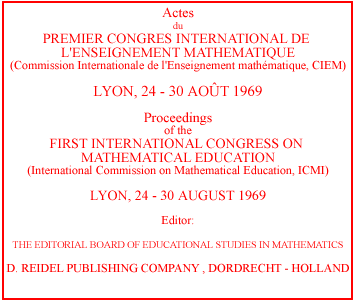
Proceedings of the First International Congress on Mathematical Education

ICME-1    1969      Lyon (France)

D. Reidel Publishing Company | 1969 | 286 páginas | pdf | 27,4 Mb
online: mathematik.uni-bielefeld.de

djvu - 13,8 Mb
online: mathematik.uni-bielefeld.de


All the papers of the congress are also published in 
Educational Studies in Mathematics (1969-70), Vol. 2, 134-418. 


Contents
H. FREUDENTHAL, Allocution (p. 3) 
B. CHRISTIANSEN, Induction and Deduction in the Learning of Mathematics and in Mathematical Instruction (p. 7) 
W. SERVAIS, Logique et enseignement mathématique (p. 28) 
J. V. ARMITAGE, The Relation between Abstract and 'Concrete' Mathematics at School (p. 48) 
R. GAUTHIER, Essai d'individualisation de l'enseignement (Enfants de dix à quatorze ans)(p. 57) 
G. G. MASLOVA, Le développement des idées et des concepts mathématiques fondamentaux dans l'enseignement des enfants de 7 a 15 ans (p. 69) 
A. ROUMANET, Une classe de mathématique: motivations et méthodes (p. 80) 
E. G. BEGLE, The Role of Research in the Improvement of Mathematics Education (p. 100) 
A. DELESSERT, De quelques problèmes touchant à la formation des maîtres de mathématiques (p. 113) 
A. ENGEL, The Relevance of Modern Fields of Applied Mathematics for Mathematical Education (p. 125) 
A. REVUZ, Les premiers pas en analyse (p. 138) 
A. MARKOUCHEVITCH, Certains problèmes de l'enseignement des mathématiques à l'école (p. 147) 
E. FISHBEIN, Enseignement mathématique et développement intellectuel (p. 158) 
E. CASTELNUOVO, Différentes représentations utilisant la notion de barycentre (p. 175) 
F. PAPY, Minicomputer (p. 201) 
B. THWAITES, The Role of the Computer in School Mathematics (p. 214) 
Z. KRYGOWSKA, Le texte mathématique dans l' enseignement (p. 228) 
H.-G. STEINER, Magnitudes and Rational Numbers - A Didactical Analysis (p. 239) 
H. O. POLLAK, How Can we Teach Applications of Mathematics? (p. 261) 
P. C. ROSENBLOOM, Vectors and Symmetry (p. 273) Resolutions (English) (p. 284) Résolutions (French) (p. 285) 


Mathematics in Western Culture

Morris Kline

Oxford University Press | 1964 | 512 páginas |

online : archive.org


This book gives a remarkably fine account of the influences mathematics has exerted on the development of philosophy, the physical sciences, religion, and the arts in Western life.

Table of Contents
I Introduction. True and False Conceptions, 3
II The Rule of Thumb in Mathematics, 13
III The Birth of the Mathematical Spirit, 24
IV The Elements oi Euclid, 40
V Placing a Yardstick to the Stars, 60
VI Nature Acquires Reason, 74
VII Interlude, 89
VIII Renewal of the Mathematical Spirit, 99
IX The Harmony of the World, no
X Painting arid Perspective, 126
XI Science Born of Art: Projective Geometry, 144
XII A Discourse on Method, 159
XIII The Quantitative Approach to Nature, 182
XIV The Deduction of Universal Laws, 196
XV Grasping the Fleeting Instant: The Calculus, 214
XVI The Newtonian Influence: Science and Philosophy, 234
XVII The Newtonian Influence: Religion, 257
XVIII The Newtonian Influence: Literature and Aesthetics, 272
XIX The Sine of G Major, 287
XX Mastery of the Ether Waves, 304
XXI The Science of Human Nature, 322
XXII The Mathematical Theory of Ignorance: The Statistical Approach
to the Study of Man, 340
XXIII Prediction and Probability, 359
XXIV Our Disorderly Universe: The Statistical View of Nature, 376
XXV The Paradoxes of the Infinite, 395
XXVI New Geometries, New Worlds, 410
XXVII The Theory of Relativity, 432
XXVIII Mathematics: Method and Art, 453

segunda-feira, 10 de março de 2014

A Handbook of Mathematical Discourse


Charles Wells


Infinity Publishing | 2003 | 300 páginas 

pdf (versão draft - 2002) - online: 

ljk.imag.fr
abstractmath.org

Para mais livros sobre linguagem e comunicação em matemática procure em: link

What sort of book is this? It is a dictionary of sorts of all those words and conventions you had questions about as an undergraduate or graduate student but were afraid to ask, for fear of sounding dumb. Nobody, especially not your professors, bothered to explain these words, because they knew them so well and used them so automatically that it never occurred to them that you might not know to use them.
For example, a student might be confused by the many different ways mathematicians use let. This book explains, with illustrative examples, that let can mean assume or suppose, that it can be used to introduce a new symbol when considering successive cases (Let n > 0.... Now let n<0 font="" nbsp="">to introduce an arbitrary object when proving a for all statement (Let g∈G; we need to prove that…), or
to define a concept (Let an integer be even if it is divisible by 2),
as well as several other meanings. That students are not clear about the use of words like let can be seen from Steve Maurer’s PRIMUS article, “Advice for undergraduates on special aspects of writing mathematics” (Vol. 1, pp. 9–28, 1991).
A student might want to know what a bound variable is — not many transition-to-proof course textbooks cover that very well, if at all. There is a definition here, and it comes with a picture. Whether or not you like the somewhat quirky line drawings, however, depends on your sense of humor: next to the entry for bound variable, one finds an X with lots of rope around its middle. If you know already know the meaning of bound variable, you may be amused by this play on words. However, if you are a student trying to understand its meaning, I doubt it would help.
You can browse the book like a coffee table book (though its size is much smaller at 8 by 8 inches) or like a dictionary, which it resembles. Give it to your favorite math major or beginning graduate student to help enculturate him/her into mathematicians’ sometimes unusual usage of terms and phrases. You might also consider using it as a prize for a math contest or as an addition to your departmental math library.

quinta-feira, 6 de março de 2014

A Mathematician's Apology


University of Alberta Mathematical Sciences Society | 2005 | 56 páginas | pdf | 174 kb

online: math.ualberta.ca

Cambridge University Press | 1967 | 80 páginas

online: archive.org

G. H. Hardy was one of this century's finest mathematical thinkers, renowned among his contemporaries as a 'real mathematician ... the purest of the pure'. He was also, as C. P. Snow recounts in his Foreword, 'unorthodox, eccentric, radical, ready to talk about anything'. This 'apology', written in 1940 as his mathematical powers were declining, offers a brilliant and engaging account of mathematics as very much more than a science; when it was first published, Graham Greene hailed it alongside Henry James's notebooks as 'the best account of what it was like to be a creative artist'. C. P. Snow's Foreword gives sympathetic and witty insights into Hardy's life, with its rich store of anecdotes concerning his collaboration with the brilliant Indian mathematician Ramanujan, his aphorisms and idiosyncrasies, and his passion for cricket. This is a unique account of the fascination of mathematics and of one of its most compelling exponents in modern times.

Para mais livros sobre filosofia da matemática procure em: link