Mostrando postagens com marcador Aprendizagem da Matemática. Mostrar todas as postagens
domingo, 6 de abril de 2014
Soviet studies in the psychology of learning and teaching mathematics - Volumes 7 - 14
This is one of a series that is a collection of translations from the extensive Soviet literature of the past 25 years on research in the psychology of mathematics instruction. It also includes works on methods of teaching mathematics directly influenced by the psychological research. Selected papers and books considered to be of value to the American mathematics educator have been translated from the Russian and appear in this series for the first time in English. The aim of this series is to acquaint mathematics educators and teachers with directions, ideas, and accomplishments in the psychology of mathematical instruction in the Soviet Union.
Volume VII - Children's Capacity for Learning Mathematics
Steffe, Leslie P., Ed.; And Others
1975 | 276 páginas | pdf
online: ERIC
The work of El'konin, Davydov, and Minskaya reported in this volume represents a start toward the alleviation of the lack of theory-based experimental investigations of mathematics learning and teaching.
TABLE OF CONTENTS
Introduction, Leslie Steffe
Learning Capacity and Age Level, D. B. El'konin and V. V..Davydov
Primary Schoolchildren's Intellectual Capabilities and the Content of Instruction, D. B. El'konin
Logical and Psychological Problems of Elementary Mathematics as an Academic Subject, V. V. Davydov
The Psychological Characteristics of the "Prenumerical" Period of Mathematics Instruction, V. V. Davydov
Developing the Concept of Number by Means of the Relationship of Quantities, G. I. Minskaya
Volume VIII - Methods of Teaching Mathematics
Steffe, Leslie P., Ed.; And Others
1975 | 290 páginas | pdf
online: ERIC
This volume contains four articles: Principles, Forms, and Methods of Mathematics Instruction; ; ; and Independent Work for Pupils in Arithmetic Lessons in the Early Grades
TABLE OF CONTENTS
Introduction, Leslie P. Steffe
Principles, Forms, and Methods of Mathematics Instruction, I. A. Gibsh
The Relation Between Mathematics Instruction and Life, G. G. Maslova and. A. D. Semushin
The Pupil's Activity as a Necessary Condition for Improving the Quality of Instruction, I. A. Gibsh
Independent Work for Pupils in Arithmetic Lessons in the Early Grades, M. I. More
Volume IX - Problem Solving Processes of Mentally Retarded Children
Clarkson, Sandra P., Ed.; And Others
1975 | 184 páginas | pdf
online: ERIC
The articles in this volume are concerned with the instruction in problem solving of mentally retarded pupils in the auxiliary schools of the Soviet Union. Both articles in this volume describe research in problem solving and also provide concrete suggestions for improving instruction. The literature reviews contained in these articles provide us with much information on the state of research in the Soviet Union on problem solving in mathematics.
TABLE OF CONTENTS
The Solution of Complex Arithmetic Problems in Auxiliary School, K. A. Mikhal'skii
Basic Difficulties Encountered in Auxiliary School Pupils in Solving Arithmetic Problems, M. I. Ku'mitskaya
Volume X - Teaching Mathematics to Mentally Retarded Children
Clarkson, Sandra P., Ed.; And Others
1975 | 184 páginas | pdf
online: ERIC
The articles in this volume deal with the instruction in geometry and arithmetic of mentally retarded pupils in the Soviet Union. These pupils attend special schools, called auxiliary schools, where they are trained in content that can later be related to specific job skills. Authors of the articles have attempted to identify the specific knowledge that the pupils possess and to design more effective instructional methods for increasing that knowledge.
TABLE OF CONTENTS
Introduction
Instructing Auxiliary School Pupils in Visual Geometry, P. G. Tishini
Visual.and Verbal Means in Pregaratory Exercises in Teaching Arithmetic Problem Solving, N. F. Kuimina-Syromyatnikova
Some Features of Elementary Arithmetic Instruction for Auxiliary School Pupils, T. V. Khanutina
Volume XI - Analysis and Synthesis as Problem Solving Methods
Kantowski, Mary Grace, Ed.; And Others
1975 | 186 páginas | pdf
online: ERIC
This volume differs from the others in the series in that the entire volume records the search for a method of problem-solving instruction based on the analytic-synthetic nature of the problem-solving process. In this work, Kalmykova traces the history of the use of the analytic and synthetic methods in her country, explores elementary classroom situations involving teachers who had various degrees of success in problem-solving instruction, makes hypotheses regarding the use of certain techniques, and concludes with suggestions for "productive" methods to be used in the classroom
TABLE OF CONTENTS
Introduction, Mary C. Kantowski
Chapter I. Overview
Chapter II. Substantiation of the Problem of Analysis end Synthesis
Chapter III. Experimental Investigations of the Use of the Method of Analysis in School
Chapter IV. Experimental Investigations of Analysis as a Method of Searching for a Solution
Chapter V. Productive Method of Analysis and Synthesis
Volume XII - Problems of Instruction
Wilson, James W., Ed.; And Others
1975 | 185 páginas | pdf
online: ERIC
The seven studies found in this volume are: ;; ;;; ; and Psychological Characteristics of Pupils' Assimilation of the Concept of a Function.
TABLE OF CONTENTS
Introduction
An Experiment in the Psychological Analysis of Algebraic Errors, P. A. Shevarev
Pupils' Comprehension of Geometric Proofs, F. N. Gonoboldn
Elements of the Historical Approach in Teaching Mathematics, I. N. Shevchenko
Overcoming Students' Errors in the Independent Solution of Arithmetic Problems, 0. T. Yochkovskaya
Stimulating Student Activity in the Study of Functional Relationships, Yu. I. Goldberg
Psychological Grounds for Extensive Use of Unsolvable Problems, Ya. I. Grudenov
Psychological Characteristics of Pupils' Assimilation of the Concept of a Function, I. A. Marnyanskii
Volume XIII - Analysis of Reasoning Processes
Wilson, James W., Ed.; And Others
1975 | 244 páginas | pdf
online: ERIC
The analysis of reasoning processes in the learning of concepts or the solving of problems is the theme common to the ten articles in this volume. These articles, except for the first one by Ushakova, were published between 1960 and 1967 and were part of the available literature during a revision of the Soviet school mathematics curriculum. The articles are interesting because of the topics they treat and because of the research styles they illustrate
TABLE OF CONTENTS
Introduction, James Wilson and Jeremy Kilpatrick
The Role of Comparison in-the Formation of Concepts do by Third-Grade Pupils, M. N. Ushakova
On the Formation of an Elementary Concept of Number by the Child, V. V. Davydov
The Generalized Conception in Problem Solving, A. V. Brushlinskii
An Analysis of the Process of Solving Simple Arithmetic Problem, G. P. Shchedrovitskii and S. G. Yak'obson
An Attempt at an Experimental Investigation of Psychological Regularity in Learning, B. B. Kopov
The Formation of Generalized Operations as a Method for Preparing Pupils to Solve Geometry Problems Independently, E. I. Mashbits
An Experimental Investigation of Problem Solving and Modeling the Thought Processes, D. N.Zavalishin and V. N. Pushkin
The Composition of Pupils' Geometry Skills, A. K. Artemov
On the Process of Searching for an Unknown-While Solving a Mental Problem, A. V. Brushlinskii
The Mechanisms of Solving Arithmetic Problems, L. M. Fridman
Volume XIV - Teaching Arithmetic in the Elementary School
Hooten, Joseph R., Ed.; And Others
1975 | 214 páginas | pdf
online: ERIC
The six chapter titles are:
The Psychological and Didactic Principles of Teaching Arithmetic;
The Introduction of Numbers, Counting, and the Arithmetical Operations;
Instruction in Mental and Written Calculation; Teaching Problem Solving;
Geometry in the Primary Grades;
Different Kinds of Pupils and How to Approach Them in Arithmetic Instruction.
Marcadores:
Aprendizagem da Matemática,
Ensino da Matemática,
Psicologia
quarta-feira, 2 de abril de 2014
Research on mathematical thinking of young children : six empirical studies
Leslie P. Steffe
National Council of Teachers of Mathematics | 1975 | 207 páginas | pdf | 3,2 Mb
online: ERIC
Para outros livros relacionados procure em: link
This volume includes reports of six studies of the thought processes of children aged four through eight. In the first paper Steffe and Smock outline a model for learning and teaching mathematics. Six reports on empirical studies are then presented in five areas of mathematics learning: (1) equivalence and order relations; (2) classification and seriation; (3) interdependence of classification, seriation, and number concepts; (4) Boolean Algebra; and (5) conservation and measurement. In a final chapter, the main findings of these papers are summarized and implications are discussed, with suggestions for further research.
Table of Contents
Introduction, Leslie P. Sleffe 1
I.On a Model for Learning and Teaching Mathematics, Leslie P. Sleffe and Charles D. Smock 4
II.Learning of Equivalence and Order Relations by Four- and Five-Year-Old Children, Leslie P. Sleffe and Russell L. Carey,19
III.Learning of Equivalence and Order Relations byDisadvantaged Five- and Six-Year-Old Children, Douglas T. Owens 47
IV.Learning of Classification and Seriation by Young Children, R Marlin L. Johnson 73
V.The Generalization of Piagetian Operations as It Relates to the Hypothesized Functional Interdependence between Classification, Seriation, and Number Concepts, Richard A. Lesh 94
VI.Learning of Selected Parts of a Boolean Algebra by Young Children, David C. Johnson 123
VII.The Performance of Mist- and Second -Grade Children on Liquid Conservation and Measurement Problems Employing Equivalence and Order Relations, Thomas P. Carpenter 145
Summary and Implications, Kennelh Lovell 171
References 191
National Council of Teachers of Mathematics | 1975 | 207 páginas | pdf | 3,2 Mb
online: ERIC
Para outros livros relacionados procure em: link
This volume includes reports of six studies of the thought processes of children aged four through eight. In the first paper Steffe and Smock outline a model for learning and teaching mathematics. Six reports on empirical studies are then presented in five areas of mathematics learning: (1) equivalence and order relations; (2) classification and seriation; (3) interdependence of classification, seriation, and number concepts; (4) Boolean Algebra; and (5) conservation and measurement. In a final chapter, the main findings of these papers are summarized and implications are discussed, with suggestions for further research.
Table of Contents
Introduction, Leslie P. Sleffe 1
I.On a Model for Learning and Teaching Mathematics, Leslie P. Sleffe and Charles D. Smock 4
II.Learning of Equivalence and Order Relations by Four- and Five-Year-Old Children, Leslie P. Sleffe and Russell L. Carey,19
III.Learning of Equivalence and Order Relations byDisadvantaged Five- and Six-Year-Old Children, Douglas T. Owens 47
IV.Learning of Classification and Seriation by Young Children, R Marlin L. Johnson 73
V.The Generalization of Piagetian Operations as It Relates to the Hypothesized Functional Interdependence between Classification, Seriation, and Number Concepts, Richard A. Lesh 94
VI.Learning of Selected Parts of a Boolean Algebra by Young Children, David C. Johnson 123
VII.The Performance of Mist- and Second -Grade Children on Liquid Conservation and Measurement Problems Employing Equivalence and Order Relations, Thomas P. Carpenter 145
Summary and Implications, Kennelh Lovell 171
References 191
terça-feira, 28 de maio de 2013
Reconceptualizing Early Mathematics Learning (Advances in Mathematics Education)
Lyn D. English, Joanne T. Mulligan
Springer | 2013 | 339 páginas
Procure em: link
This book emanated primarily from concerns that the mathematical capabilities of young children continue to receive inadequate attention in both the research and instructional arenas. Research over many years has revealed that young children have sophisticated mathematical minds and a natural eagerness to engage in a range of mathematical activities. As the chapters in this book attest, current research is showing that young children are developing complex mathematical knowledge and abstract reasoning a good deal earlier than previously thought. A range of studies in prior to school and early school settings indicate that young learners do possess cognitive capacities which, with appropriately designed and implemented learning experiences, can enable forms of reasoning not typically seen in the early years. Although there is a large and coherent body of research on individual content domains such as counting and arithmetic, there have been remarkably few studies that have attempted to describe characteristics of structural development in young students’ mathematics. Collectively, the chapters highlight the importance of providing more exciting, relevant, and challenging 21st century mathematics learning for our young students. The chapters provide a broad scope in their topics and approaches to advancing young children’s mathematical learning. They incorporate studies that highlight the importance of pattern and structure across the curriculum, studies that target particular content such as statistics, early algebra, and beginning number, and studies that consider how technology and other tools can facilitate early mathematical development. Reconceptualising the professional learning of teachers in promoting young children’s mathematics, including a consideration of the role of play, is also addressed.
Índice
Contents
Perspectives on Reconceptualizing Early Mathematics Learning . . . . . 1
Lyn D. English and Joanne T. Mulligan
Early Mathematics Learning in Perspective: Eras and Forces of Change . 5
Kristie J. Newton and Patricia A. Alexander
Early Awareness of Mathematical Pattern and Structure . . . . . . . . . 29
Joanne T. Mulligan and Michael C. Mitchelmore
Reconceptualizing Early Mathematics Learning: The Fundamental Role of Pattern and Structure . 47
Joanne T. Mulligan, Michael C. Mitchelmore, Lyn D. English, and Nathan Crevensten
Reconceptualizing Statistical Learning in the Early Years . . . . . . . . . 67
Lyn D. English
Cognitive Guidelines for the Design and Evaluation of Early Mathematics Software: The Example of MathemAntics . . . . . . . . 83
Herbert P. Ginsburg, Azadeh Jamalian, and Samantha Creighan
Rethinking Early Mathematics: What Is Research-Based Curriculum for Young Children? . . . 121
Douglas H. Clements and Julie Sarama
Reflecting on Young Children’s Mathematics Learning . . . . . . . . . . 149
Bob Perry and Sue Dockett
Practices that Support Mathematics Learning in a Play-Based Classroom 163
Anita A. Wager
Communicating About Number: Fostering Young Children’s Mathematical Orientation in the World . . . 183
Bert van Oers
A Framework for Examining Technologies and Early Mathematics Learning . 205
Kristy Goodwin and Kate Highfield
The Role of Picture Books in Young Children’s Mathematics Learning . . 227
Marja Van den Heuvel-Panhuizen and Iliada Elia
Improving Numeracy Outcomes for Young Australian Indigenous Children . . 253
Marina M. Papic
Enhancing Teacher Professional Development for Early Years Mathematics TeachersWorking in Disadvantaged Contexts . . . . . 283
Elizabeth Warren and Janine Quine
Mathematical Modeling at the Intersection of Elementary Mathematics,Art, and Engineering Education . . . 309
Heidi A. Diefes-Dux, Lindsay Whittenberg, and Roxanne McKee
sexta-feira, 17 de setembro de 2010
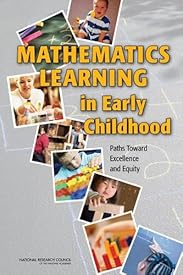
Mathematics Learning in Early Childhood: Paths Toward Excellence and Equity

Committee on Early Childhood Mathematics, National Research Council
National Academies Press | 2009 | 398 páginas
on-line: nap.edu
Early childhood mathematics is vitally important for young children's present and future educational success. Research has demonstrated that virtually all young children have the capability to learn and become competent in mathematics. Furthermore, young children enjoy their early informal experiences with mathematics. Unfortunately, many children's potential in mathematics is not fully realized, especially those children who are economically disadvantaged. This is due, in part, to a lack of opportunities to learn mathematics in early childhood settings or through everyday experiences in the home and in their communities. Improvements in early childhood mathematics education can provide young children with the foundation for school success.
Relying on a comprehensive review of the research, Mathematics Learning in Early Childhood lays out the critical areas that should be the focus of young children's early mathematics education, explores the extent to which they are currently being incorporated in early childhood settings, and identifies the changes needed to improve the quality of mathematics experiences for young children. This book serves as a call to action to improve the state of early childhood mathematics. It will be especially useful for policy makers and practitioners-those who work directly with children and their families in shaping the policies that affect the education of young children.
quinta-feira, 12 de março de 2009
Assinar:
Postagens (Atom)